Posts Tagged ‘electronic health records’

Obama to Give $600 Million to Community Health Centers

December 9th, 2009

Obama to give $600 million to health centers

President Barack Obama said Wednesday he will allocate nearly $600 million from the $787 billion economic stimulus plan to help create jobs at 85 community health centers.

Obama is under heavy pressure to generate job growth in the United States, with the November unemployment rate at 10 percent.

Republicans say the economic stimulus package passed in February by the Democratic-controlled Congress has had little impact, but Democrats counter that the stimulus pulled the country back from the brink of an even deeper recession.

The White House said nearly $600 million would awarded to help pay for major construction and renovation projects at 85 community health centers across the country and assist networks at the centers to move to electronic records.

The funds are expected not only to create new jobs in construction and healthcare, but also to help provide care for more than 500,000 additional patients in underserved communities, the White House said.

Obama pressed his case for bipartisan support for healthcare reform, saying the U.S. healthcare system takes a toll not just in high costs and lost workdays, but on Americans who suffer because they are unable to afford care.

“No matter what party we belong to, or where on the political spectrum we fall, none of us thinks this is acceptable. None of us would defend this system. That’s why we’ve taken up the cause of health insurance reform this year,” Obama said.

Obama also announced a new demonstration initiative to support the delivery of advanced primary care to elderly and disabled Medicare patients through community health centers.

“Taken together, these three initiatives — funding for construction, technology and a medical home demonstration — they won’t just save money over the long term and create more jobs,” Obama said in remarks just before signing the memo authorizing the demonstration project.

“They’re also going to give more people the peace of mind of knowing that healthcare will be there for them and their families when they need it and ultimately that’s what health insurance reform is really about,” he said. “That’s what the members of Congress here today will be voting on in the coming weeks.”

To qualify for funding, a facility must be a federally qualified “community” health center.

(Reporting by Steve Holland and Patricia Zengerle, editing by Mohammad Zargham)

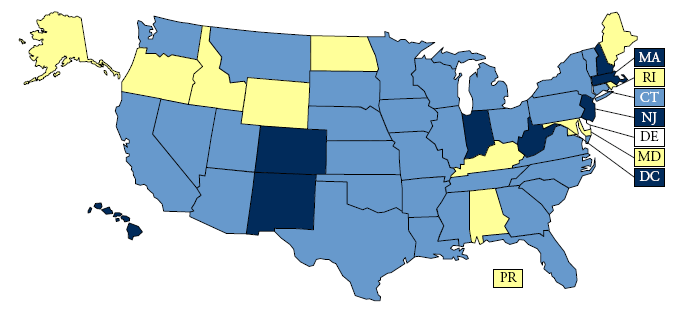
Map of CHCs

Map of CHCs

Share Hawaii EHR:
  • Twitter
  • LinkedIn
  • Facebook
  • Yahoo! Bookmarks
  • Digg
  • del.icio.us
  • Mixx
  • Google Bookmarks
  • MySpace
  • Furl
  • Spurl
  • Technorati
  • YahooMyWeb
  • email
  • LinkaGoGo
  • StumbleUpon

Social Security Administration Seeks Electronic Health Record (EHR) System

September 28th, 2009

The Social Security Administration Seeks Services for the Development of an Electronic Health Record (EHR)

The Social Security Administration requires a contractor to provide the application software, associated licenses, training, hosting of data, technical support and consultation services for the development of an Electronic Health Record (EHR) in accordance with the attached solicitation. This requirement is 100% set-aside for small business. The applicable NAICS code is 541512 and the size standard is $25 million.

Contract Performance shall begin October 1, 2009. The Solicitation Number: SSA-RFQ-09-2171 can be found here.

There are currently a total of thirty Employee Health Centers (EHCs) nationwide; twenty-seven of these are staffed through an interagency agreement with Federal Occupational Health (FOH).  Currently, all medical records, logs and statistics are kept on paper.

The new automated system will be released as a pilot version among the six EHU’s at SSA Headquarters.  If the pilot version is successful the system may be implemented by SSA EHC’s nationwide.  National implementation shall not begin until at least one year after contract award.

There are six Employee Health Units (EHUs) at Headquarters (Main Complex, Security West, Meadows East, Metro West, National Computer Center (NCC), and Woodlawn Office Complex).  Each health unit provides preventative health care guidance/counseling to employees and medical care of ill or injured employees, contractors and visitors.

Some of the more interesting requirements include (please send a reply or comment if you know what “lactation support” is):

  • System shall have the ability to attach any SSA form requested by the OMD, as a pop-up that automatically populates applicable fields, and can be completed and printed or e-mailed.
  • System shall have the ability to create custom templates that meet our exact criteria, ability to modify templates at any time, free text boxes available on all fields as desired by SSA OMD.
  • No two users shall be able to access the same chart concurrently.
  • Electronic signature pads shall be provided, functional, and installed for each workstation by the contractor.
  • System shall have the ability to share information electronically, in bidirectional mode, with private physician offices in a secure, HIPPA (sic) compliant manner.
  • The posting is dated September 14. The closing time and date for receipt of offers is 4:00 P.M. EST on September 18, 2009. Contract Performance shall begin October 1, 2009.
  1. Data Requirements - The EHR shall capture the following data elements for each employee.  This list may be expanded or changed by the OMD at any time and the contractor shall accommodate these changes within a predetermined and reasonable amount of time.   Each element shall be marked as:

P – Pre-filled; M – Mandatory; O – Optional; G – Systems generated; or S – Sensitive

(a)    Employee Data Elements

  • Last Name                                                                   M
  • First Name                                                                   M
  • Middle Initial                                                                O
  • Full SSN (only the last 4 will be displayed)                    M
  • Date of Birth                                                                 M
  • Building                                                                        M
  • Work Location                                                             M
  • Employee Status                                                           M
    • Employee
    • Contractor
    • Visitor

(b)    Nurse Data Elements

  • First Name                                                                   M
  • Last Name                                                                   M
  • Middle Initial                                                                O
  • Health Unit                                                                   M

(c)    Case Data Elements

  • Date of Visit                                                                 M S  P (System Generated)
  • Time-In                                                                        M S
  • Time-Out                                                                     M
  • Health Unit (drop down menu)                                      M
  • Reason for Visit (more than 1 can be selected)              M
    • Allergy Program
    • Assessment and Treatment of injury/illness
    • Blood Pressure Check
    • Flu-Program
    • Follow-up
    • Health Counseling
    • International Travel
    • Lactation Support
    • Self-Care program
    • Vaccinations
    • Other (free text box)
Share Hawaii EHR:
  • Twitter
  • LinkedIn
  • Facebook
  • Yahoo! Bookmarks
  • Digg
  • del.icio.us
  • Mixx
  • Google Bookmarks
  • MySpace
  • Furl
  • Spurl
  • Technorati
  • YahooMyWeb
  • email
  • LinkaGoGo
  • StumbleUpon

Federal Funds Incentives Establishing Electronic Health Information Exchanges

April 28th, 2009

Legislators Scrambling to Establish Electronic Health Information Exchanges

Sen. Joe Paskvan, D-Fairbanks, Alaska, pushed a bill that would establish an electronic health information exchange system that would draw on federal funds.

In response to President Obama’s mandate for electronic health records (EHR) for all patients, SMART Association, Inc. and LifeMed Card, Inc. (“SMART”) announce they have released their LifeMed™ Smart Card Platform software for EHRs.

Currently, healthcare information management focuses on exchanging patients’ electronic medical records over the Internet to various HIEs and Regional Health Information Organizations (RHIOs). From there, networks are supposed to connect and aggregate information into a National Health Information Network (NHIN). Therefore, correctly identifying patients while protecting their privacy is a daunting task. Randy Vanderhoof, executive director of the Smart Card Alliance (http://www.smartcardalliance.org), states, “Secure identity smart cards should be top of mind for any government policy makers looking to improve the efficiency of healthcare information.”

Kauai Hawaii

The blog at Health IT Politics reviewed interviews conducted at the WHCC, World Healthcare Congress, (www.worldhealthcare.org). “Dr. Davis reviewed various metrics of population health across nations. Apparently, EMR/Health IT adoption is at 28% in the U.S. versus 98% in the Netherlands.  More importantly, only 30% of U.S. physicians have pay-for-performance incentives.  Dr. Davis cited Denmark as good example of EMR utilizations.  Denmark has a single Health Information Exchange for citizens’ data.  This data can be accessed by a physician through a portal.”

Share Hawaii EHR:
  • Twitter
  • LinkedIn
  • Facebook
  • Yahoo! Bookmarks
  • Digg
  • del.icio.us
  • Mixx
  • Google Bookmarks
  • MySpace
  • Furl
  • Spurl
  • Technorati
  • YahooMyWeb
  • email
  • LinkaGoGo
  • StumbleUpon

ARRA, HI-TECH, HITech or HITECH?

April 14th, 2009

Interoperability and the ‘HITECH Act’’

How can a word or acronym be overused before it’s even known? We all know what interoperability is, but does it exist? In Hawaii? In short, no. Don’t believe me? Do a Google search on “interoperability Hawaii”. Go ahead, I’ll wait. Nada, zip, zilch. As of today, there is nothing related to health information technology, or health information exchange in the top 20 spots. Why? Because it does not exist. I don’t know if there were ever 200 manufacturers (estimates vary wildly) of anything besides electronic health records, so I will use automobiles as an analogy. Take a Fiat Spider, pull off the bumper. Put it on a Chevelle, or Chevy Camaro Rally Sport.

2009 Chevrolet Camaro EHR (Extra Hot Rod)

2009 Chevrolet Camaro EHR (Extra Hot Rod)

Please use a new one, don’t ruin a classic. How does it look? Probably pretty darned strange considering the 2009 Camaro has no bumper – until you bolted that thing on it. My point? EHR interoperability is just a concept, not reality. There are several local organizations that claim to be “experts” in interoperability. As of now, there are none. When you can order a lab test, upload it to the laboratory, download it to the EHR, then transfer the results to another EHR across town, THEN we can talk about expertise.

Enter SOA, or service oriented architecture. “IBM’s healthcare strategy is based on the adoption of an SOA approach and the use of open standards and standards-based electronic health records to provide secure and private exchanges of records between authorized healthcare provider and healthcare payer organizations.” Well said. Getting the 300+ various systems to talk to each other will be the challenge. Think UN. Many companies are working on health information exchange, but in a different way. Before we can be interoperable, we must be functional. You have to put the data in, first. Implementation of these systems will be the single greatest initial challenge, by far.

Which takes me to HITECH. Interoperability is only mentioned 3 times in the entire 220 page document. Not an accident I think. Standards is mentioned well over 100 times, however. So, what is HITECH? What’s in this bill? Unfortunately, there is no easy way to explain it intelligently, so you should read it, or at least do a speed read on it. I know it’s painful, but fortunately, it’s double spaced and only half the normal width of a regular document, it’s a lot like my high school essays, except with useful content. Here’s a quick, plagiarized summary:
‘‘Sec. 3001. Office of the National Coordinator for Health InformationTechnology.
‘‘Sec. 3002. HIT Policy Committee.
‘‘Sec. 3003. HIT Standards Committee.
‘‘Sec. 3004. Process for adoption of endorsed recommendations; adoption of initial set of standards, implementation specifications, and certification criteria.
‘‘Sec. 3005. Application and use of adopted standards and implementation specifications by Federal agencies.
‘‘Sec. 3006. Voluntary application and use of adopted standards and implementation specifications by private entities.
‘‘Sec. 3007. Federal health information technology.
‘‘Sec. 3008. Transitions.
‘‘Sec. 3009. Miscellaneous provisions.
Sec. 13102. Technical amendment.
PART 2—APPLICATION AND USE OF ADOPTED HEALTH INFORMATION TECHNOLOGY STANDARDS; REPORTS
Sec. 13111. Coordination of Federal activities with adopted standards and implementation specifications.
Sec. 13112. Application to private entities.
Sec. 13113. Study and reports.
Subtitle B—Testing of Health Information Technology
Sec. 13201. National Institute for Standards and Technology testing.
Sec. 13202. Research and development programs.
Subtitle C—Grants and Loans Funding
Sec. 13301. Grant, loan, and demonstration programs.
‘‘Subtitle B—Incentives for the Use of Health Information Technology
‘‘Sec. 3011. Immediate funding to strengthen the health information technology infrastructure.
‘‘Sec. 3012. Health information technology implementation assistance.
‘‘Sec. 3013. State grants to promote health information technology.
‘‘Sec. 3014. Competitive grants to States and Indian tribes for the development of loan programs to facilitate the widespread adoption of certified EHR technology.
‘‘Sec. 3015. Demonstration program to integrate information technology into clinical education.
‘‘Sec. 3016. Information technology professionals in health care.
‘‘Sec. 3017. General grant and loan provisions.
‘‘Sec. 3018. Authorization for appropriations.
Subtitle D—Privacy
Sec. 13400. Definitions.
PART 1—IMPROVED PRIVACY PROVISIONS AND SECURITY PROVISIONS
Sec. 13401. Application of security provisions and penalties to business associates of covered entities; annual guidance on security provisions.
Sec. 13402. Notification in the case of breach.
Sec. 13403. Education on health information privacy.
Sec. 13404. Application of privacy provisions and penalties to business associates of covered entities.
Sec. 13405. Restrictions on certain disclosures and sales of health information; accounting of certain protected health information disclosures; access to certain information in electronic format.
Sec. 13406. Conditions on certain contacts as part of health care operations.
Sec. 13407. Temporary breach notification requirement for vendors of personal health records and other non-HIPAA covered entities.
Sec. 13408. Business associate contracts required for certain entities.
Sec. 13409. Clarification of application of wrongful disclosures criminal penalties.
Sec. 13410. Improved enforcement.
Sec. 13411. Audits.
PART 2—RELATIONSHIP TO OTHER LAWS; REGULATORY REFERENCES;
EFFECTIVE DATE; REPORTS
Sec. 13421. Relationship to other laws.
Sec. 13422. Regulatory references.
Sec. 13423. Effective date.
Sec. 13424. Studies, reports, guidance.

See, that wasn’t so bad. I feel and look smarter already. OK, now you can relax and take that test drive. We have a long way to go. Once you wade through the HITECH Act, I’ll post the ARRA, all 407 pages of it.

Bumblebee Camaro EHR

Bumblebee Camaro EHR

.

Share Hawaii EHR:
  • Twitter
  • LinkedIn
  • Facebook
  • Yahoo! Bookmarks
  • Digg
  • del.icio.us
  • Mixx
  • Google Bookmarks
  • MySpace
  • Furl
  • Spurl
  • Technorati
  • YahooMyWeb
  • email
  • LinkaGoGo
  • StumbleUpon

Federally Qualified Health Centers Ready for EHRs

April 14th, 2009

Numerous Federally Qualified Health Centers are Ready for Electronic Health Records

Crusader Community Health one of the largest Federally Qualified Health Centers (FQHCs) in Illinois, has chosen eClinicalWorks unified electronic medical records (EMR) and practice management (PM) solution for its 54 providers and four locations. Crusader Community Health is a community-based, not-for-profit community health center.

Salud Family Health Centers, a community health center, provides health services to all the residents of a defined catchment area, covering parts of Weld, Boulder, Adams, Larimer, Morgan and Logan Counties, Colorado. Salud is part of the Colorado Associated Community Health Information Exchange, a consortium of 14 Colorado health centers. These include Mountain Family Health Centers, Salud Family Health Centers, Pueblo Community Health Centers, Denver Health, Colorado Community Health Network, Clinica Family Health Services, Valley-Wide Health Systems, Peak Vista Community Health Centers, Sunrise Community Health, Salud Family Health Centers, Metro Community Provider Network, and High Plains Community Health Center.

Due to reporting requirements for the UDS, or Uniform Data System, almost every community health center on the country has chosen GE Centricity, or eClinicalWorks as its EHR.

Most recently, HealthNet, the largest Federally Qualified Health Center (FQHC) in Indiana, “has chosen eClinicalWorks unified electronic medical records (EMR) and practice management (PM) solution for its more than 110 providers and resident physicians in eight locations.”  These consist of

HealthNet Barrington Health Center
HealthNet Care Center at the Tower
HealthNet Martindale-Brightwood Health and Dental Center
HealthNet Pediatric & Adolescent Care Center
HealthNet People’s Health & Dental Center
HealthNet Southeast Health & Dental Center
HealthNet Southwest Health Center
HealthNet Southwest OB Annex

Projects such as these will ramp up quickly. Too quickly.  The federal government’s economic stimulus package is dedicating $19 billion to speeding the adoption of electronic health records, so demand for health informatics specialists is skyrocketing. “My rough estimate is that we need about 70,000 health informaticians,” said Don E. Detmer, president and chief executive of the American Medical Informatics Association, a nonprofit industry group.

Share Hawaii EHR:
  • Twitter
  • LinkedIn
  • Facebook
  • Yahoo! Bookmarks
  • Digg
  • del.icio.us
  • Mixx
  • Google Bookmarks
  • MySpace
  • Furl
  • Spurl
  • Technorati
  • YahooMyWeb
  • email
  • LinkaGoGo
  • StumbleUpon

HITECH Raises The Bar on Privacy Standards

April 9th, 2009

According to Manatt, Phelps & Phillips, LLP, “HITECH directly regulates business associates for the first time. While not subjecting business associates to all of the obligations of covered entities (such as providing privacy notices), the statute requires business associates to comply with the HIPAA security rule provisions mandating administrative, physical and technical safeguards. It also requires them to adhere to the terms of their business associate agreements, including the restrictions on the use and disclosure of protected health information.”

Click here to see the provisions of the ‘‘American Recovery and Reinvestment Act of 2009’’.

“(A) requirements relating to security, privacy, and notification in the case of a breach of security or privacy (including the applicability of an exemption to notification in the case of individually identifiable health information that has been rendered unusable, unreadable, or indecipherable through technologies or methodologies recognized by appropriate professional organization or standard setting
bodies to provide effective security for the information) that should be applied to—
(i) vendors of personal health records;
(ii) entities that offer products or services through the website of a vendor of personal health records;
(iii) entities that are not covered entities and that offer products or services through the websites of covered entities that offer individuals personal health records;
(iv) entities that are not covered entities and that access information in a personal health record or send information to a personal health record; and
(v) third party service providers used by a vendor or entity described in clause (i), (ii), (iii), or (iv) to
assist in providing personal health record products or services;”

It’s interesting to note that vendors are considered non-HIPAA covered entities. At some point, personal health records, electronic health records and vendors of these services will start to blend together. New territory.

Share Hawaii EHR:
  • Twitter
  • LinkedIn
  • Facebook
  • Yahoo! Bookmarks
  • Digg
  • del.icio.us
  • Mixx
  • Google Bookmarks
  • MySpace
  • Furl
  • Spurl
  • Technorati
  • YahooMyWeb
  • email
  • LinkaGoGo
  • StumbleUpon

About

February 10th, 2009

Aloha, I can be reached at frank@hawaiiehr.com or 808.723.0900. My LinkedIn profile is located at http://www.linkedin.com/in/frankdiaz1

About Hawaii EHR

The purpose of Hawaii EHR is to disseminate electronic health information in the areas where government, politics and the private sector meet.

About Frank Diaz

Frank is the Writer/Publisher of Hawaii EHR. Frank has over 10 years of direct patient care experience as well as over 10 years experience in healthcare information management (HIM).

Frank is a Consultant and Project Manager with experience in health care projects that design, and implement business and technology solutions. He is currently installing GE Centricity CPS 2006 (their first practice management system fully integrated with the electronic health record) at a federally qualified health center. It serves patients in more than 15 languages. His background is in CHCS, VistA, Medcin, AHLTA, and GE Centricity.

He holds a Masters in Business Administration from Colorado State University.  He is working towards a Master Certificate in Six Sigma – Healthcare, from Villanova University.

Share Hawaii EHR:
  • Twitter
  • LinkedIn
  • Facebook
  • Yahoo! Bookmarks
  • Digg
  • del.icio.us
  • Mixx
  • Google Bookmarks
  • MySpace
  • Furl
  • Spurl
  • Technorati
  • YahooMyWeb
  • email
  • LinkaGoGo
  • StumbleUpon